National Battleship Registry
USS Nevada BB-36
Alternate Names: The Cheer Up Ship

History
USS Nevada
- 12/07/1941, At 0748 on December 7, 1941, the Attack on Pearl Harbor began with Nevada being the last ship on Battleship Row, located aft of USS Arizona. Prior to the attack Nevada had one of her six boilers lit ever since she had returned to port, with the Officer of the Deck, Joe Taussig ordering a second boiler lit off earlier in the morning. As Nevada began to raise steam and her gunners opened fire, a single 18in torpedo exploded against her port side at Frame 41 about 14ft above the keel at 0810. Seconds later, the torpedo bomber that dropped the torpedo was shot down by Nevada's gunners. Though her torpedo bulkhead held, Nevada suffered flooding between frames 30 and 43 in addition to a 4-5 degree list. Her damage control crews corrected the list with counter flooding, and at 0840, thanks to the actions of Ensign Taussig, Nevada became the only battleship to get underway during the attack. Nevada's commanding officer Captain Francis W. Scanland was ashore when the attack began and Nevada got underway under the command of Lt. Cmdr Francis J. Thomas who found himself senior officer aboard. Having already shot down four Japanese planes Nevada began her slow, but courageous charge up the channel, her defiant charge rallying sailors fighting aboard the other ships along battleship row. However, Nevada's charge made her a prime target for the Japanese planes and as she steamed past Ten-Ten Dock Nevada was hit by five bombs. One bomb hit exploded over the crews galley. Another struck the port director platform and exploded at the base of the stack. Yet another struck the No. 1 turret and blew large holes in the upper and main decks. Two hit the forecastle near frame 15; one passed out through the side of the 2nd deck before exploding, the other exploded within the ship near the gasoline tank leading to intense fires throughout the ship. Nevada had gotten lucky as the fire around the No.1 turret may have cause a magazine detonation had the ship not been in the process of switching out her older projectiles for newer ones, and so her crew had not yet loaded the new powder charges. As the bomb damage became evident Nevada was ordered to beach on the west side of Ford Island to prevent her sinking in deeper water. At 1030 Nevada grounded at Hospital Point on Ford Island, but not before downing three more Japanese planes. Fires prevented damage control crews from containing flooding forward of the main torpedo defenses. Flooding of the main magazine and counterflooding to keep the ship stable lowered the bow allowing water to come in through the bomb holes, flooding the dynamo and boiler rooms. Over the course of the attack Nevada suffered a total of 60 killed and 109 wounded, with a further 2 dying on Feb 7, 1942, during the salvage effort. Nevada suffered at least 1 torpedo hit and 6 bomb hits though it is possible she received additional bomb hits.
- 02/12/1942, On the February 12, 1942, just 2 months and 5 days after she sunk USS Nevada rose from the shallow waters of Pearl Harbor and settled in Dry Dock 2. Nevada would undergo temporary repairs at Pearl Harbor before sailing for Puget Sound Naval Shipyard for major repairs and modernization which would be completed in October 1942.
- 05/11 - 05/18/1942, USS Nevada provided fire support during the capture of Attu before sailing for Norfolk Navy Yard in June for further modernization.
- Mid - 1943, After her modernization in Norfolk was completed in mid 1943 Nevada was assigned to convoy escort duty in the Atlantic where she provided cover for allied convoys against a possible attack by German surface raiders. After many convoy escort missions Nevada sailed for the Britain in April, 1944, in preparation for the Normandy Landings.
- 06/06/1944, On D-Day Nevada provided naval gunfire support for forces ashore from June 6 - June 17, Nevada was the only American battleship to be present at both Pearl Harbor and at Normandy.
- 06/25/1944, Again Nevada used her main battery to provide support to ground forces this time off the Cherbourg peninsula, Nevada fired 14in shells up to twenty miles inland in attempts to break up and disrupt German concentrations and counterattacks. Nevada would be praised for her incredibly accurate fire support, with some of her shells landing just 600m from the front line, and though she was straddled twenty-seven times by counterbattery fire she was never hit.
- 08/15/1944 - 09/25/1944, Nevada supported Operation Dragoon, the landings in souther france, from August 15 to September 25, 1944. During this time Nevada would duel with "Big Willie" a heavily armed and fortified fortress armed with four 13.4in guns salvaged from the French battleship Provence, the guns had a range of 19 nautical miles, were reinforced with heavy armor plate, and commanded every approach into the French port of Toulon. Due to these dangers the ships assigned to fire support were ordered to level the fortress. Beginning on August 19, and continuing the subsequent days, one or more heavy warships would bombard the fortress along with bomber strikes. On September 23, Nevada headed the most damaging bombardment against the fort during a 6 & 1/2 hour bombardment in which Nevada fired 354 salvos. Toulon would fall on September 25, but the fortress would hold out for three more days.
- Late - 1944, After supporting Operation Dragoon Nevada sailed for New York to have her main battery gun barrels relined. During this time the three gun barrels of Turret 1 would be replaced by three 14in gun barrels that had been salvaged from USS Arizona.
- 02/16/1945, After a refit Nevada sailed to the Pacific arriving off of Iwo Jima on February 16, providing gunfire support for the invasion of the island till March 7. During the Iwo Jima invasion Nevada closed to within 600 yards from shore in order to provide maximum support for ground forces.
- 03/24/1945, Nevada would join Task Fore 54 as part of the fire support force for the invasion of Okinawa, having moved into position during the night of the 23rd, Nevada began her bombardment along with Task Force 54 as dawn rose. Nevada would shell airfields, supply depots, shore defenses, and troop concentrations.
- 03/25/1945, As dawn rose on March 25, Task Force 54 was attacked by seven Kamikazes while without air cover. One Kamikaze, hit numerous times by AA fire crashed onto the deck of Nevada, next to the No. 3 turret. Both of the 14in guns in turret 3 would be knocked out and Nevada suffered 11 killed and 49. Nevada would lose another 2 killed on April 5 from shore battery fire.
- 07/10/1945 - 08/07/1945, Nevada would join the U.S 3rd fleet allowing her to close within range of the Japanese home islands, though she did not bombard them.
- 1946, Nevada would be decommissioned due to her age and used as a target during Operation Crossroads atomic bomb tests. Nevada would survive both atomic bombs, due to her radioactivity and damage she would not be repaired. Nevada would then be used as a target off of Pear Harbor by ships including USS Iowa BB-61 on July 38, this too she would survive. Finally Nevada would be given a coup de grace and sunk with an aerial torpedo hit amidships.
- 05/11/2020, The wreck of Nevada is discovered by Ocean Infinity, with its ship the Pacific Constructor. Nevada lies upside down in a large debris field in 15,400ft of water.
Gallery
Images & Captions
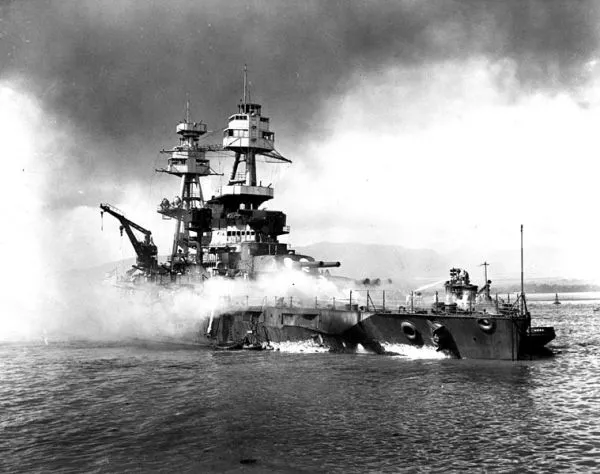
Image 1
1 / 1USS Nevada (BB-36) Grounded near Hospital Point during the Pearl Harbor attack
Credit: US Navy
Source: Task and Purpose
Service History
Commissionings
| Commissioned | Decommissioned | Comment |
|---|---|---|
| 1916-03-11 | 1946-08-29 |
Recognition
Awards
-
Asiatic-Pacific Campaign Medal
5 Battle Stars
-
European-African-Middle Eastern Campaign Medal
2 Battle Stars
- World War II Victory Medal
- World War I Victory Medal
Specifications
Overview
- Class
- Nevada-Class Dreadnought Battleship
- Builder
- Fore River Shipbuilding Company
- Keel Laid
- 1912-11-04
- Launch Date
- 1914-07-11
- Displacement
- 1916 Config: 28,900 Tons | 1942 Config: 34,445 Tons
- Speed
- 20.5 knots
- Power Plant
- 1916 Config: 12 Yarrow Oil-Fired Boilers, Geared Curtis turbines | 1942 Config: 6 Bureau Express Oil-Fired boilers, Geared Curtis turbines.
- Armor
- Belt Armor: 13.5in - 8in, Deck Armor: 6.25in - 3in, Splinter Deck Armor: 2in - 1.5in, Conning Tower Armor 16in - 8in, Turret Armor: 18in - 5in, Barbette Armor: 13in, Bulkhead Armor: 13.5in - 8in, Boiler Uptake Armor: 13in
- Final Disposition
- Sunk as as a target by aerial torpedoes and gunfire from USS Iowa BB-61 and 2 other vessels, 31 July, 1946.
Weapons
Armament
- Primary
- 10 x 14in/45 caliber guns (2x3)(2x2)
- Secondary
- 1916 Config: 21 x 5in/51 Caliber Guns (21x1) | 1927 - 1930 Refit: 12 x 5"/51 Caliber Guns (12x1) | 1942 Config: 16 x 5in/38 Caliber Dual-Purpose Guns (8x2)
- Tertiary
- 1916 Config: 2 x 3in/50 caliber Anti-Aircraft Guns (2x1) | 1927 - 1930 Refit: 8 x 5"/25 Caliber Anti-Aircraft Guns (8x1), 8 x 0.5" Browning Machine Guns | 1942 Config: 32 x 40mm Bofors Anti-Aircraft Guns (8x4), 40 x 20mm Oerlikon Anti-Aircraft Guns (40x1)
- Additional
- 4 x 21in Torpedo Tubes | 1927 - 1930 Refit: Torpedo Tubes removed
Registry Tags
Tags
Battleship